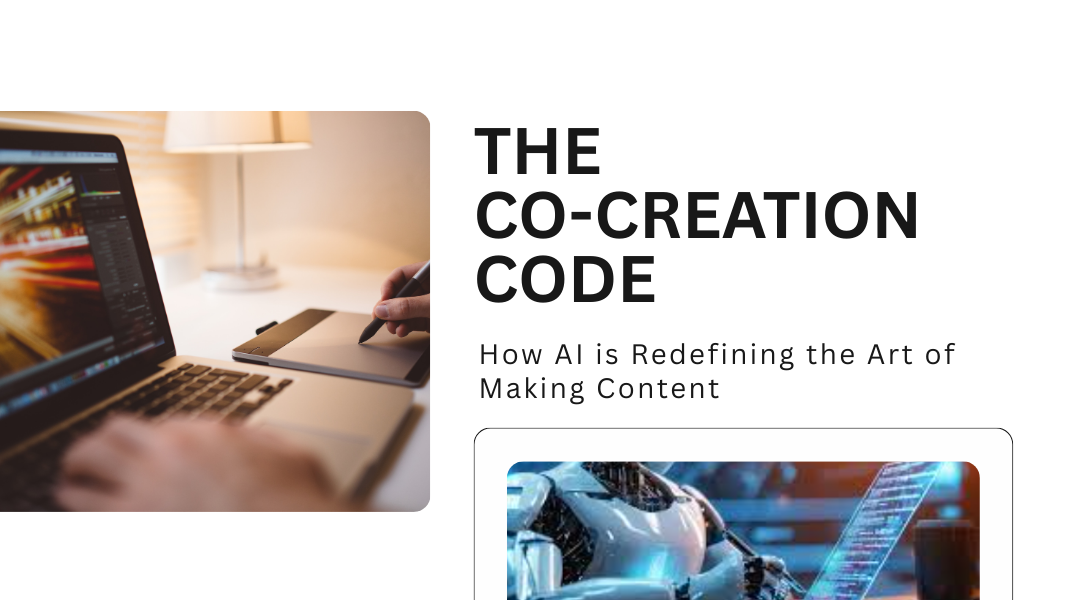
Introduction: The Silent Partner in the Creative Process
There’s a quiet revolution unfolding not in factories, but in the minds of creators. It’s happening on the blank page, the empty timeline, and the silent canvas. A new, dynamic partner is joining the creative process—one that doesn’t replace the human spark, but amplifies it. We’re no longer just staring down the barrel of creative block alone; we’re beginning a conversation with a new form of intelligence.
This shift isn’t about robots penning bestsellers or algorithms winning art prizes. It’s subtler, more profound, and far more practical. Artificial Intelligence is weaving itself into the very fabric of content creation, not as a usurper, but as a collaborative force—a co-creator. This partnership is changing the rules of the game, freeing creators from the grind of the mundane to focus on what truly matters: strategy, nuance, and the irreplaceable human touch. Let’s explore how this collaboration is reshaping the landscape for writers, designers, and visionaries.
The New Creative Workflow: From Solo Act to Dynamic Duo
The End of the Blank Page: AI as the Ultimate Brainstorming Partner
For generations, the blank page has been a symbol of daunting potential. AI tools are effectively eliminating it. They serve as a perpetual idea engine, a always-on creative collaborator.
- Conceptual Springboards: Instead of facing the void, a creator can now input a nascent thought—”a blog post about sustainable gardening for apartment dwellers”—and instantly generate a list of angles, outlines, and key talking points. It’s like having a relentless brainstorming partner who never runs out of coffee or enthusiasm.
- Tone and Style Chameleon: Need to draft a formal press release, then pivot to a witty social media caption for the same product? AI can reframe the core message across a spectrum of voices and formats, allowing creators to maintain brand consistency while adapting to different channels with agility. This moves the focus from what to write to how and where to communicate it most effectively.
Augmentation, Not Automation: Elevating the Human Role
The greatest misconception is that AI seeks to make the creator obsolete. The reality is quite the opposite: it aims to make the creator more powerful. It handles the heavy lifting, allowing human intelligence to focus on higher-order tasks.
- From Draft to Polish: An AI can produce a solid first draft in minutes, but it lacks true understanding, emotional depth, and strategic intent. The creator’s role evolves from originator of every word to strategic editor. This is where the magic happens—infusing the text with personality, verifying nuance, weaving in storytelling, and ensuring it aligns with a deeper brand narrative. The human becomes the curator of quality.
- Democratizing Visual Expression: In the visual realm, AI image generators act as a supercharged sketch artist. A marketer with a vision but no artistic training can describe a scene—”a minimalist laptop on a rustic wooden table at dawn, cyberpunk neon lights reflecting on the screen”—and receive a range of visual concepts to refine. This doesn’t replace the graphic designer; it empowers the visionary to communicate their idea more effectively, turning abstract concepts into tangible starting points for collaboration and refinement.
The Personalization Engine: Crafting Unique Audience Experiences
The one-size-fits-all approach to content is becoming a relic of the past. AI is the key that unlocks hyper-personalization at scale.
- Dynamic Content Adaptation: Imagine an educational platform where an AI can automatically rephrase a complex lesson for a 12-year-old, a college student, and a professional seeking a refresher—all from the same core material. It can tailor the language, examples, and depth to suit the learner’s context, making content more accessible and effective.
- Data-Informed Creativity: By analyzing audience engagement data, AI can provide creators with insights that were previously guesswork. It can suggest topics that are gaining traction, identify gaps in existing content libraries, and even recommend the optimal time and format for publication. This merges the art of creation with the science of analytics, leading to content that is not only well-crafted but also strategically potent.
Conclusion: The Symphony of Human and Machine
The transformation brought by AI in content creation is not a takeover; it’s an upgrade. It signals a fundamental shift from a model of solitary creation to one of collaborative co-creation. The most successful creators of tomorrow will not be those who fear the algorithm, but those who learn to conduct it.
They will be the ones who master the new workflow: leveraging AI to break through inertia, generate raw material, and handle repetitive tasks, while reserving their own expertise for the roles that truly define great content—critical thinking, emotional intelligence, strategic oversight, and injecting that final layer of soul and authenticity.
The future of content isn’t a choice between human and artificial intelligence. It’s a symphony, where the precision and scale of the machine complements the vision and depth of the human, creating a whole that is far greater than the sum of its parts. The canvas is no longer blank; it’s pre-populated with possibilities, waiting for a human guide to shape them into something meaningful.